 In February 2024, Art Workers for Palestine Scotland hosted Against The Grain, a visit to and conversation about Silent Archive, the current exhibition at Inverleith House in the Royal Botanic Gardens Edinburgh. The exhibition includes contemporary art alongside pieces from the Botanics’ collections. It aims to enable visitors to “discover hidden narratives and hear long-ignored voices” including “stories of scientific discoveries [and] colonial histories”.
The visit was organised to address the sponsorship of Inverleith House by Outset Contemporary Art Fund, a Zionist organisation that, since March 2024, is now the subject of a global labour boycott endorsed by Artists and Culture Workers LDN, Artworkers for Palestine Scotland, BDZ (Boycott Zabludowicz), Cinenova Working Group, Cultural Workers against Genocide, Goldsmiths for Palestine, Industria, Other Cinemas and The White Pube.
Edinburgh’s Botanic Gardens is both a place of leisure and an active scientific research institution whose current corporate worldview is built on colonial foundations. Botanic gardens such as Edinburgh’s played vital roles in the colonial project, their research supporting plantation economies which generated vast wealth through the labour of enslaved people. These days, Edinburgh’s researchers are closely involved in supporting environmentally damaging rubber plantations in China. Edinburgh’s Botanic Gardens also has close ties with botanic gardens in Tel Aviv, helping to normalise the Zionist project through scientific collaboration.
At Inverleith House, the last three years of contemporary art programming have been part-funded through £150,000 from Outset Contemporary Art Fund. Outset is co-founded and directed by Candida Gertler, whose husband Zak is close friends with Benjamin Netanyahu and a patron of the Jewish National Fund, which champions the Zionist mythology of ‘making the desert bloom’ and supports illegal settlements in Palestinian territory. Candida was a director of Policy Exchange, a right-wing think-tank co-founded by Michael Gove and responsible for conceiving repressive policies including the Anti-Boycott Bill which specifically targets pro-Palestinian activism. Zak is a major financial donor to Gove, who is currently pushing an Islamophobic agenda.
In 2021 the Botanics hosted Seeing the Invisible, an augmented reality exhibition in partnership with the Botanic Gardens in Jerusalem and facilitated by Outset. To mark Earth Day, this project included an online discussion involving: Candida Gertler; the then curator at Inverleith House, who is now head of visual arts at Creative Scotland; the director of the Jerusalem gardens; and various artists and curators. The discussion was hosted by TheVov, an online platform co-founded by Natasha Hersham, who is the daughter of Zak and Candida Gertler. Hersham is also one of two directors, the other being father Zak, of Gertler Property Services. TheVov is part-funded by Outset, which is supposedly overseen by the Charities Commission. Information released about the partnership between Outset and TheVov never mentions that this is a family affair. There is no record of Seeing the Invisible on the Botanics’ website.
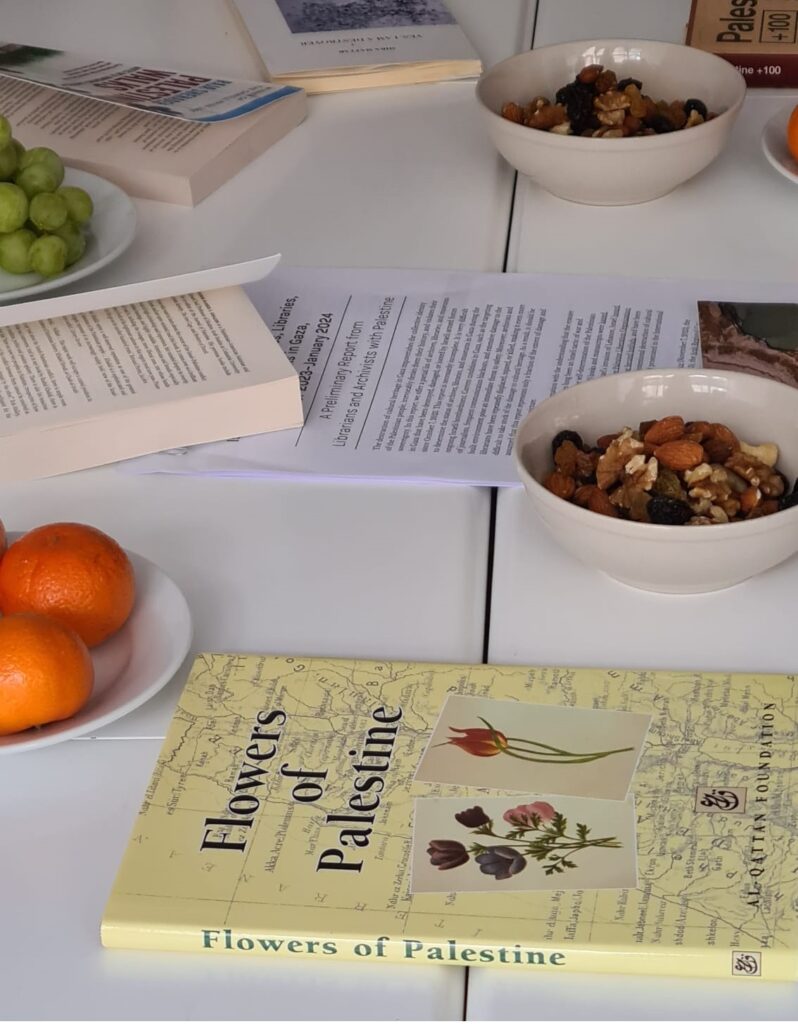 The following is a collection of thoughts from those who attended the against-the-grain visit to Silent Archive.
A gallery displaying botanic specimens is little different to a museum, and in many ways a museum of the living. The repetitive use of language without context in the exhibition – ‘restoration’, ‘migration’, ‘threatened’, ‘sanctuary’ – gestures towards protection. Yet there is little conversation around the true politics of protection, apart from the conversations we bring ourselves.
The renaming and wrong naming of trees celebrated in the first room of the exhibition is a demonstration of how easily the knowledge that exists in Indigenous communities is disregarded by colonial worldviews. This quieting of some voices and amplifying of others runs throughout the exhibition. An audio essay exploring what it means to categorise is barely audible and exhibited with no transcript, rendering the work inaccessible. Other critical pieces are boxed away in corners of cluttered rooms. With so much information, especially text, on display, will people only see what they already know? Information and context is hidden being QR codes, so those wanting to engage further have to disappear into a faceless place instead of bringing the mess into the clean and neatly arranged rooms. It feels as if everything is seen as a specimen, at times including the images of Indigenous people on display.
The exhibition claims to be amplifying “long-ignored voices”, but it still stakes its claim for control: which facets of colonialism get to be discussed; which do not. Botany’s active role in facilitating colonial profiteering is only ever described in the past tense. For the Botanics to celebrate its own protection of certain species (especially “native” species in Scotland) without mentioning how it supports, for example, rubber plantations in China, is at best duplicitous. The implication is always that the experts know best. As if scientific institutions are just a force for good these days. Edinburgh’s own direct and ongoing culpability is largely overlooked.
Silent Archive is a strange title. It suggests that the archive was silent until we arrived. But archives were never silent: those who control them simply were not listening. The only voices we hear speak in the exhibition are Scottish voices, so as the ‘silence’ is asserted only so that it can now be ‘broken’, it begs the question: who is being listened to now?
This exhibition opened on the 9th of February, 125 days into this wave of genocide against the Palestinian people and erasure of Palestinian culture. 125 days where it was possible to reframe and contextualise an exhibition that claims to ‘hear long-ignored voices.’ No conversation about the trees uprooted, no conversation about land destroyed, no mention of the toxic chemicals of warfare that could alter Palestine’s ecosystem forever. No mention of ‘making the desert bloom’, no mention of the Botanics’ partnerships with Israeli organisations.
How can the art world move beyond superficial invitations to engage with colonialism? How long will it be before arts organisations are explicit about the context in which they accept funding? If decision makers feel compromised by honesty, they need to ask themselves why. Is this a sign that further conversations are required? Or are they simply not bold enough to undertake work that meaningfully addresses today’s political context? This exhibition offers little provocation, few potential solutions, and no direct accountability. Which begs the question: who and what is it for?
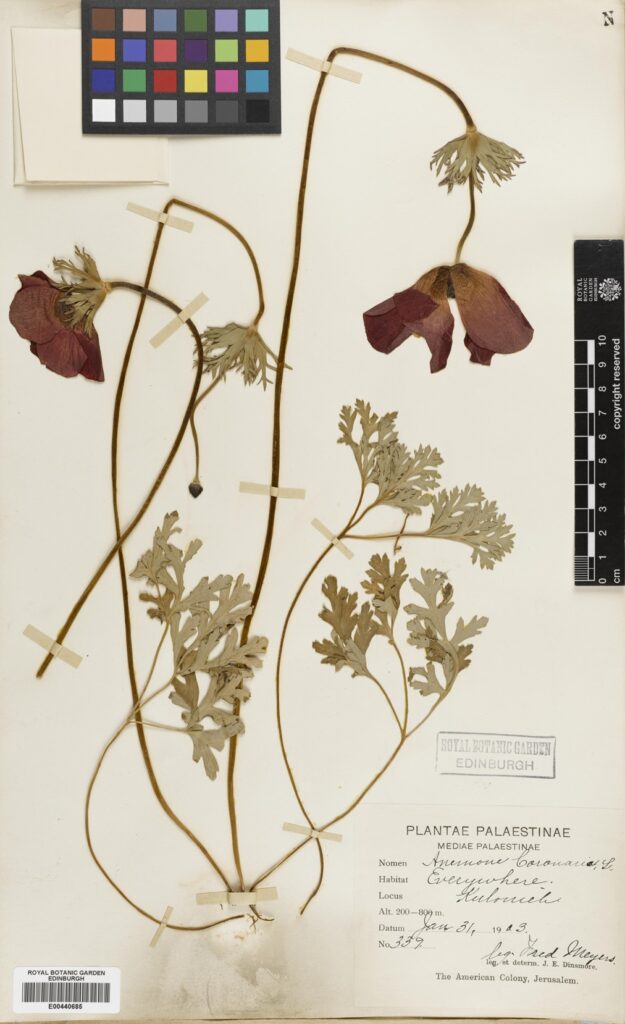
Image 1: Anemone coronaria, Plantae Palestinae, RBGE Herbarium specimen. This specimen was collected in 1903 from the Palestinian village of Kulonieh (also spelt Qalunya, Qaluniya, Colonia), by John Edward Dinsmore, director of the herbarium at the American Colony, a ‘Christian utopian society’ in Jerusalem.
Kulonieh was destroyed by Zionist paramilitaries during the Nakba in 1948.
Many Palestinian specimens held in the RBGE collection are listed in the online herbarium database under ‘Israel’.
Image 2: books and snacks at the against-the-grain group discussion, February 2024.